Thursday, May 11, 2006

Bug out!

It's not the solution to all our problems, but it is a piece of news I'm very happy to hear: Tom DeLay, in disgrace with Fortune and men's eyes, has resigned from the House, effective June 9th. Raw Story has his resignation letter.

Of course, even as we toast his overdue departure, we should remember that his stink isn't leaving Washington entirely; he's simply moving it to another part of the Iron Triangle he helped forge. Money quote from the resignation letter:
I have recently made the decision to pursue new opportunities to engage in the important cultural and political battles of our day from an arena outside of the U.S. House of Representatives.
Setting aside for the moment any court appearances or prison terms that might be in his future, expect Delay simply to move to one of the many right-wing lobbying and influence organizations that flourished under his tenure, as what the Washington Post delicately calls a "corporate-paid legislative strategist."

Still, we're not sending him home from the Hill empty-handed, are we Johnny?

Well, Bill, we've got a special "Bug Man" edition of our p3 bumper sticker:


The air over Capitol Hill is just a tiny bit less foul tonight. Mr. DeLay, it's okay this time if you go ahead and let the door hit you in the ass on the way out.

I'm thinking of a number: It's less than 30 but more than 28 ...

The statistically and politically inevitable has happened, and what better place to read about it than the Wall Street Journal?
President Bush’s job-approval rating has fallen to its lowest mark of his presidency, according to a new Harris Interactive poll. Of 1,003 U.S. adults surveyed in a telephone poll, 29% think Mr. Bush is doing an “excellent or pretty good” job as president, down from 35% in April and significantly lower than 43% in January.

Roughly one-quarter of U.S. adults say “things in the country are going in the right direction,” while 69% say “things have pretty seriously gotten off on the wrong track.” This trend has declined every month since January, when 33% said the nation was heading in the right direction. Iraq remains a key concern for the general public, as 28% of Americans said they consider Iraq to be one of the top two most important issues the government should address, up from 23% in April. The immigration debate also prompted 16% of Americans to consider it a top issue, down from 19% last month, but still sharply higher from 4% in March.
That whistling sound you hear is a coyote-shaped object reaching terminal velocity somewhere over the desert floor.

Wednesday, May 10, 2006

"No tax" pledges: That's so 1998

The mud war between GOP gubernatorial wannabes Ron Saxton and Kevin Mannix (well on his way to becoming the Harold Stassen of Oregon politics) (Look it up.) continues. And I couldn't be happier.

It's a treat we get here in Oregon every four years, and it makes me a little sad to think we only get to watch it for another six days: Republican candidates competing to prove their loyalty to their national movement base like Grover Norquist's Americans for Tax Reform, and turning off most Oregon voters in the process.

Erstwhile moderate Repub Ron Saxton is trying to get to the right of social conservative Mannix by adding qualifiers to his support for reproductive choice and painting Mannix, improbably, as a tax-and-spend liberal in everything but the name.

Saxton's latest TV ad runs as follows:
"Newspapers call Kevin Mannix attacks on Ron Saxton a smear, sleazy. Is Mannix attacking to hide his $350,000 campaign debt, or his 83 votes to raise taxes? Eighty three votes for higher gas taxes, sales taxes, and Mannix opposed limiting property tax increases. Ron Saxton signed a no new taxes pledge. Ninety percent of newspapers endorse Saxton, calling him a fiscal conservative. If you want change, vote for Ron Saxton."
(Haven't been able to find the ad online yet; when I do I'll link to it.)

A press release on Mannix's site assures us that he too signed the ATR's no-tax pledge, although the accuracy of Saxton's suggestion (i.e., that the fact that he signed such a pledge distinguishes him from Mannix) isn't really the point here.

The point is, come this fall, neither one of them is going to be bragging about ties to Grover Norquist, as investigations continue into the Republican sleaze machine created by Norquist, Jack Abramoff, and Tom DeLay. The only candidate who'll be interested in mentioning it--and oh, he will, at every opportunity--will be the Democrat.

And at a more fundamental level, the point is that "no tax" pledges are a gimmick, and about as honest, workable, and reliable as abstinence pledges, another far-right favorite.* Anyone who signs such a pledge and means it--saying, in effect, "I promise to govern with one hand tied behind my back"--isn't serious and doesn't deserve election. That would be as useless as a President who never used the veto. (Psych!)

Of course the presidential veto analogy really makes my point: The "no tax" pledge, like Bush signing a law he doesn't intend to obey, is fundamentally dishonest, and it corrupts the link between the will of the voters and the laws that are passed. True, Bush has not vetoed a single bill, even those he thought unconstitutional--but he did accompany his signature with hundreds of signing statements, a constitutional end-run first developed by Samuel Alito during the Reagan administration. In many of these statements Bush has declared that, for all intents and purposes, he does not consider himself bound by the very bill which his signature makes the law of the land. No, he doesn't veto; instead he pulls a constitutional fast one.

Same with "no tax" pledges. Even drown-it-in-the-bathtub extremists like Norquist still want some money coming into the government coffers to fund their pet projects. They just want to make sure the money doesn't come from the people on their speed dialers (i.e., the people living on capital gains and trust funds, and big corporations), but rather from the rest of us--the chumps. So in lieu of taxes, we'll pay surcharges, service fees, tolls, access charges, increased costs of privatized and poorly-regulated services, bigger co-pays, steeper deductibles--but, of course, no new taxes.

It's pretty simple, really: Vote for candidates who sign "no tax" pledges, and be a chump. Come November, Oregon voters can show that they get it.

*I forgot to include "term limits pledges," yet another empty Republican gimmick. And like the other faux pledges, it conceals the real problem: The upward-spiralling cost of privately funded campaigns and the disproportionate power of incumbency, especially when most districts have been scientifically rigged to make them safe.

Tuesday, May 9, 2006

Presidential power dive

Tom Tomorrow has charted approval and disapproval ratings for Nixon and Bush, month by month, at comparable points during their presidencies. They're locked in a Wile E. Coyote-esque dive, although we know the polls for Nixon ended abruptly in August 1974, while Bush has 986 more days (in theory, at least) to plumb the sociometric depths.

As TT reminds us, the amazing thing about this accomplishment is that Bush has managed to sink this low without the "benefit" of bipartisan congressional hearings on his conduct. In fact, he's had the GOP-controlled Congress covering his back at every turn. No one to blame here but himself (exactly the sort of situation he resents).

Josh Marshall points out that, when Bush's numbers are this low (within the margin of error of breaking the 30% barrier), it's just a matter of time now until some poll results put his approval rating at 28% or 29%. (This would be the statistical equivalent of the distant sound of Wile E. hitting the canyon floor hundreds of feet below, with only the tiny cloud of dust visible from the cliff top.)

But, as Marshall notes, Bush will have to work harder for every percentage point he drops from now on, because he's already plummeted through the thin air of moderates, undecideds, and converts, and now he's hit the hard granite of his base:
Mind you, I'm not saying that the president's popularity will continue to fall into the 20s. The continuing descent is something like a mathematical limit. Each point lower digs deeper into the base of truly committed partisans and unquestioning hacks. So knocking off each new point on the way down requires ever greater displays of incompetence, failure and general infamy.
And yet (here's a sentence I don't often utter!), Bush may be just the man for the job. Chill the champagne and polish the stemware; that 20-something number is just a matter of time now.

(Thanks to Nick at DL for sending me the charts.)

Sunday, May 7, 2006

Sunday morning toons

Still struggling to get caught up around here.

But meanwhile, Larry Wright of the Detroit News captures a line of thought I confess I've found myself on more than once: Let them take Monday off, and I'll take Monday off--and then we'll see whose phone rings first.

And as long as we're on the subject, here's a concurring opinion from Signe Wilkinson of the Philadelphia Daily News.

More to follow.

Thursday, May 4, 2006

Gotta get down to it

Year by year, this is more like remembering when a "disappointed office-seeker" shot Garfield (sadly, the president, not the cartoon cat), but with a few minutes left of the fourth of May, I want to mention that today is the 36th anniversary of this.
What if you knew her
And found her dead on the ground
How can you run when you know?
On April 30th, 1970, President Nixon announced on national television that the US had for some time been bombing Cambodia--a neutral country, through which the North Vietnamese were running supply lines. This came as a shock to the American public, although not so much to the Cambodians, who (as Doonesbury noted at the time) had noticed the bombing right away.

Demonstrations of protest broke out on campuses across the country. And on May 4th, four students were killed, and three more wounded, by National Guard fire at Kent State. Let's be clear: American citizens were shot while protesting an illegal military action by their government.

Within about two weeks, Neil Young had written, recorded with Crosby, Stills & Nash, pressed, and distributed "Ohio."

And now, he's got a new album with the cut "Let's Impeach the President." I'm so delighted that I can link to the lyrics at--of all places--Fox News. (You can hear the whole album streaming here.)

I'd like to think that the moral is: Don't lie to the American public and conduct illegal, clandestine wars to protect your presidency.

But perhaps the moral is simply this: Don't piss off sixty-year-old Canadian rockers.

Sunday, April 30, 2006

My Dinner with Colbert: a post-mortem

Okay, I've watched it twice now, and here's my take:
  1. White House Correspondents Dinner bits are like the office Christmas Party skits we used to write and perform in grad school: The whole premise is self-congratulatory and self-indulgent, but it's great fun if you're the one getting to write the material. The best material is, therefore, the shortest. Their invariable failing is that they go on too long, with too many inside jokes.

  2. I think that the "Colbert bombed" meme, currently in rapid-response deployment from the right, doesn't have much to it. That's a huge, accoustically crappy room, and--despite what we outsiders or the people at the front table might think, the activities at the front of the room are the least important to the attendees. They're there to see and be seen, to network for their next job, to find the person they slept with after the last Dinner, and so on. Colbert could have done jumping jacks in the nude and only gotten a slightly more animated response.

  3. Bush's bit, with his clear-speaking alter ego, was funnier than it will get credit for, although it also ran so long it killed the effect.

  4. Now to the centerpiece of the evening: Colbert had several moments that were, indeed, funny as hell and satirically right on target. I've said before that the evolving genius of Colbert's schtick is that it lets him "go right" on conservatives--applauding, rather than attacking, their worst moments and eagerly demanding more. (One dreads to use the phrase "Swiftian irony" at a moment like this, but there we are.) Tonight was a good example of that. In one sense, it did indeed show brass balls on Colbert's part to do that material in Bush's presence. But in another sense, it's at least as safe to do it there as to do it in the Comedy Central studio in New York.

    The Editor & Publisher report that the Bushes left the dinner in a sour mood probably oversells the outcome: They dislike the things anyway, and they knew they would be taken safely back inside the bubble again once it was over, to a place where jibes like Colbert's didn't exist, didn't matter. For all we know, if no one briefed Bush on the existence of Colbert he might well have had no clue who he was. And it was way, way too long: those great few moments came in a speech that was something like ten minutes long. The speech could have been edited down by at least a third (the film by half) and been funnier for the improved pacing, but then both would have lost all the insider-ness that is the Dinner's sine qua non. Always remember: This wasn't a prime-time special edition of the Colbert Report; it was a side-show at a D.C. insiders' love fest.

  5. Finally, and for reasons that should be clear by now, I think Carla's right: the event itself is as disposable as a Kleenex; what will last--if anything does--are the few sound bites that manage to get some traction outside the bubble. My favorite remains the bit about "deck chairs on the Hindenberg:" it was fast, perfectly timed, precisely delivered, and captures a nice truth about both the Bush administration and the fact-free spin battle that characterizes much of the coverage of it.
Your thoughts?

Correspondents' Dinner--most surreal moment

The pre-dinner ritual of the red carpet walk--without the actual red carpeting--was sort of interesting, in a B-list kind of way: Look: There's the chairman of the Federal Reserve! Look: There's Anna Devere Smith! Look! There's Ludacris! Look! There's Greta Van Susteren!

And you knew who it was, because C-SPAN helpfully provided the names at the bottom of the screen.

And then Joe Wilson and his wife made their entrance into the lobby, and C-SPAN dutifully put up the name: Valerie Plame, CIA Analyst.

Saturday, April 29, 2006

"Deck chairs on the Hindenberg:" Colbert has a good night

In the early 1990s, President George H. W. Bush was a fan of the impersonations of him by SNL star Dana Carvey--so much so that Carvey was his overnight guest at the White House.

Steven Colbert probably needn’t worry about packing his overnight bag or scoring some “TWH” monogram towels for his guest bath anytime soon. Editor & Publisher has the first reports of Colbert’s performance at tonight’s White House Correspondent Dinner:
Colbert, who spoke in the guise of his talk show character, who ostensibly supports the president strongly, urged the Bush to ignore his low approval ratings, saying they were based on reality, “and reality has a well-known liberal bias.”

Noting those low ratings, Colbert advised, "The glass isn't half empty - it's 68% empty. There's still some fluid in there, but I wouldn't drink it."

He attacked those in the press who claim that the shake-up at the White House was merely re-arranging the deck chairs on the Titanic. “This administration is soaring, not sinking,” he said. “They are re-arranging the deck chairs--on the Hindenburg.”

Colbert told Bush he could end the problem of protests by retired generals by refusing to let them retire. He compared Bush to Rocky Balboa in the “Rocky” movies, always getting punched in the face—“and Apollo Creed is everything else in the world.”

Turning to the war, he declared, "I believe that the government that governs best is a government that governs least, and by these standards we have set up a fabulous government in Iraq."

He noted former Ambassador Joseph Wilson in the crowd, as well as " Valerie Plame." Then, pretending to be worried that he had named her, he corrected himself, as Bush aides might do, "Uh, I mean... Joseph Wilson's wife." He asserted that it might be okay, as prosecutor Patrick Fitzgerald was probably not there.

The Boy King was not amused, if the phrase "the president and First Lady gave him quick nods, unsmiling, and left immediately" is any indication.

Crooks and Liars has the (hefty) video download, and if you’re one of those whose TV loads faster than your internet connection, C-SPAN will be rerunning it early tomorrow morning.)

(Compare E&P’s Colbert-centric version with the write-up by AP—seems doubtful they went to the same dinner.)

Saturday morning toons

A friend and I have been discussing the "addiction" meme--the idea that America's relationship to foreign oil is that of an addict to their fix--ever since Bush worked it into his State of the Union address.

Actually, we've been debating whether it's reached true "meme" (i.e., self-replicating mind-virus) status, or whether it was just a blip on the radar screen of presidential blather.

The New York Observer's R. J. Matson offers evidence it's the former.

Friday, April 28, 2006

Serves me right for going to bed after "The Word"

I've rarely found that the interviews on "The Colbert Report" to be that entertaining or enlightening, so I usually cash it in at about 11:40pm Pacific, Monday through Thursday.

Which is why I missed Colbert's interview with Bill Kristol last night--sorry to everyone who came looking for it here. For the record, Crooks & Liars has the video, and Think Progress has the transcript of the juicy part.

Sorry I didn't stay up for that one. In general, Colbert's faux interviews are more interesting when the target is someone on the right, rather than the left, I think. His general approach--which, in fairness, is much better honed because the show has survived its initial 8-week shakedown cruise--is for his character to go right. With guests from the left or of no obvious political position, that ends up kind of mushy. But when you've got a full-tilt right winger like Kristol on, Colbert is able to out flank him--on the even-more-right--and say, "Why aren't you all the way out here with me?" The results made even Kristol nervous.

The overall effect was reminiscent of Spy Magazine at its satirical and subversive best (check #7).

Tuesday, April 25, 2006

Countdown

Sometime today, the clock will roll over.

If you're the proud owner of a Backwards Bush keychain, you should be advised that it's counting down the hours until 12:01am January 20th, 2009--not until noon, Eastern time, on that day, when whoever replaces Dubya takes the oath of office.

That means that when your keychain turns over to zeros, it's time to pop the champagne, not to turn on C-SPAN. Just a little public-service clarification.

Of course, there remains the question: If Bush has 999 more days in which to do what he will to this country, will there be much left for the next President (assuming succession hasn't yet been banned by presidential fiat) to govern?

Playing catch-up

I'm slowly getting back up to speed after a few days of being everywhere but here at p3.

So let me lump a handful of not-quite-fleshed-out items from my notes and to-do list into one post, herewith:


Belated Saturday toons

First of all, is it me, or is Non Sequitur flying some surprisingly subversive stuff under the radar? Like the arc last month about the little girl who founded her own religion--and if boys wanted to join they had to wear a bag over their heads so that the girls wouldn't have to look at them? Surprising stuff from the syndicators of Garfield. Well, in any case, long-time p3 reader James the Elder and I couldn't send each other this one fast enough last week.

Tom Toles reminds us that all this "shake-up" at the White House doesn't have a whole lot of "shake" to it, and very little "up," either.

(And just for the record, replacing "Flopsweat" McClellan with someone whose middle name isn't "Snow Job," but might as well be, should probably be called the Late Night Comedy Writers Relief Act of 2006: The joke writers for Letterman, Stewart, Maher, and Leno can all take off early for a few days after his appointment is announced.)


Campaign finance reform--on its way down, or up?

Portland's voter owned election regs took a pie in the face already--or two, depending on how you slice it. I still stand by it, and hope they can get the bugs out of it before the big corporate donors of yore manage to get it overturned, thus restoring bidness as usual.

But if I'm still optimistic--even hoping that public financing will eventually catch on (much like vote-by-mail) around the Beaver State after it's run a few cycles in Portland and the rest of the state can see that the sky didn't fall--that is as nothing compared to the mood of Dan Meek, who's ready to take clean money statewide right now.

Money quote:
Consider the numbers: Corporations pushed up the total reported spending on candidate races in Oregon from $4.2 million in 1996 to $42 million in 2002. Candidates for seats in the Oregon Legislature spent $3.5 million in 1996, but $18 million in 2004. And 75 percent of that money came from only 1 percent of the contributors. It now typically costs more than $500,000 to win a contested seat in the Oregon Senate and more than $250,000 to win such a seat in the Oregon House of Representatives.

And while we're on state politics:


Let me just reiterate my long-held theory that term limits in Salem have, on the whole, made things worse, not better.

As Janie Har described last week's 6-hour special session of the Legislature in the Big O, the astonishing part of the story may not be that they managed to slow the fiscal power-dive of our public schools and even make a dent in the racket that is the payday loan industry--it's that Repubs and Dems managed to work together to do it.

Term limits throw fuel on the fire of partisan bickering by minimizing the payoff for building relations across the aisle. By the time you succeed, they're out of office and so are you. The rewards go to those who throw red-meat to their supporters so that they'll have a war chest to run for something else when their term limits expire.

The whole term-limits movement was tinkering with the wrong side of the supply/demand equation: If you want to get rid of bought and paid for hacks, don't force everyone out after a set time, reduce the power of incumbency (see above, re: voter owned elections).


And continuing on the same thread:

It's good that the legislature put some limits on the payday loan industry, but because it was a fig leaf of political expediency, the next stiff wind could blow it away, exposing what's underneath. (Quick--someone call the Metaphor Abuse Hotline.)
Gov. Ted Kulongoski is expected to sign new limits on payday loan rates into law next week, but supporters of the limits acknowledge that Oregon's battle over short-term loans isn't over.

The reason is the new limits on interest rates that legislators approved Thursday won't take effect until July 2007. And that leaves plenty of time for payday lenders and their lobbyists to try to weaken the law.

The lenders say the new limits would be too restrictive and could put them out of business. Some lawmakers echoed those remarks during this week's one-day special session and said the Legislature should revisit the issue during next year's regular session.
"Revisit" indeed. They'll "revisit" it in much the same way that German, British, and American armies "revisited" all those little towns and villages in Belgium in the early 1940s.

By the way: Here's a shout-out to all the "community charter" credit unions who are offering an alternative to the predatory payday loansharks. The short-term (and loss-leader) loans are at credit-card rates, not the usurious rates of the payday sharks, and they're structured so that you can't get in trouble by constantly rolling them over (the heart of the sharks' business plan). We like credit unions.

Friday, April 21, 2006

Leaking for political purposes: IOKIYAR*

*It's Okay If You're A Republican
I want Congress to hear loud and clear, it is unacceptable behavior to leak classified information when we have troops at risk.
- George W. Bush, October 2001
You had a leak? You call what's goin' on around here a leak? Boy, the last time there was a leak like this, Noah built hisself a boat.

Good lord. How many of Dubya's people have now been implicated in leaking classified or confidential information for political gain? Can anyone keep track?

Let's see--there's Dubya himself, of course, and Unca Dick Cheney, and Cheney's former Chief of Staff Scooter Libby, and Bush's Brain Karl Rove--

--and now Condi Rice has been added to the list.

(Remember that, every time her name is brought up as a GOP presidential candidate in 2008, or as a politically palliative replacement for Cheney in 2006.)

And, of course, Republicans leaking for political purposes didn't start in 2000; the Ken Starr investigation/inquisition leaked like a sieve, for no purpose other than to harass Bill Clinton.

In fact, the problem was recognized even before the Starr's reign of terror. I've never been a fan of the Bush Dynasty, but it's still amazing how far the genetic line can fall in a single generation:
I have nothing but contempt and anger for those who betray the trust by exposing the name of our sources. They are, in my view, the most insidious of traitors.

- George H. W. Bush, 1999

Bush the compulsive risk-taker

I'm adding to the sidebar Readings this piece by John Dean tracing how Bush's psychological profile, compared to other presidents, predicts that he'll roll the big dice when he feels like his presidency is threatened--as it is now, beset by policy breakdowns, corruption scandals, military failures, and public disapproval.

If the choice in Bush's mind is between admitting his presidency has collapsed and, let's say, bombing Iran--well, don’t count on retiring on the income from your Tehran timeshare. I've blogged more about it over at PK.

Wednesday, April 19, 2006

A White House riddle:

If Scottie "Flopsweat" McClellan announces his resignation, and no one believes him, does he still have his job?

I suppose it's at least worth noting that he finally agreed to comment on a personnel matter.

McClellan, who replaced Ari Fliescher as White House press secretary, never really showed his predecessor's zest for lying. Oh, he did it, like the trouper he is, and he even made it all his own by adding a certain Seinfeldian rhythm (although Abbot and Costello were the true inspiration) to the back-and-forth of the press gaggle. But you could always detect a certain amount of self-loathing, for being in this position, that was simply never there with Fleischer.

As SNL's Weekend Update observed, "McClellan says he'd like to spend more time lying for his family."

But he's not going home empty-handed. No, we're not going to send away the man who gave us this memorable exchange--
Q: I'm saying, why did you stand there and say he was not involved?

A: Again, while there is an ongoing investigation, I'm not going to be commenting on it nor is ... .

Q: Any remorse?

A: Nor is the White House, because the president wanted us to cooperate fully with the investigation, and that's what we're doing.
--and so many more, without a lovely parting gift. Johnny, what have we got for Scott?

Well, Bill, we've got this lovely p3 bumper sticker!


Thanks Johnny! And now, who's our next contestant?

Tuesday, April 18, 2006

Reading: Bernstein on full congressional investigation

Carl Bernstein has a good piece in this month's Vanity Fair, with the no-nonsense title "Senate Hearings on Bush, Now." You can read the article here, and my take on it over at Preemptive Karma.

But before you go, here's a little taste. Bernstein calls for "a full [Senate] investigation of the conduct of the presidency of George W. Bush."
How much evidence is there to justify such action?

Certainly enough to form a consensus around a national imperative: to learn what this president and his vice president knew and when they knew it; to determine what the Bush administration has done under the guise of national security; and to find out who did what, whether legal or illegal, unconstitutional or merely under the wire, in ignorance or incompetence or with good reason, while the administration barricaded itself behind the most Draconian secrecy and disingenuous information policies of the modern presidential era.
I'm adding this to the Readings list in the sidebar.

Monday, April 17, 2006

Orthogonal vectors

Looks like the Dems and the Repubs are going to be running at right angles to one another when it comes to defining the issues for this November's elections--and about frickin' time, too.

We've had enough parallelism--enough of the Dems assuring us they're like the Repubs, only less so in the bad ways: Sightly less carefree about going to war. A little more measured in their enthusiasm for corporate deregulation. A bit less comfortable with the abdication of Congressional oversight. And so on.

What America needs--desperately needs--is a real, unapologetic, full-frontal, let-someone-else-be-polite, take-no-prisoners campaign about the fundamental differences between the Democratic party and the Republican party.

Maybe--possibly--perhaps!--we're going to get it.

The Republicans, evidently as in thrall of the Fundamentalist Right and the Corporatists as ever, have been handed their to-do list for the fall, with items such as:
  • Protection of marriage amendment
  • Anti-flag burning legislation
  • Further limits on abortion
If anyone still needs proof that the GOP is the Party of Campaigning Not Governing, this agenda is it. The catalog of issues facing Americans but missing from this fundamentalist/corporatist shopping list is breathtaking:

Iraq? Silence.

Corruption? Not a word.

Health care? Mum's the word.

The economy? Well, at least they do have a word here--three, in fact: "more tax cuts"--so should we consider that an improvement?

Meanwhile, from the Democrats, looking for some way to crawl back out of the cellar but apparently still reluctant to try those stair-thingies, we're finally beginning to hear promising-sounding statements like this:
  • Tell the truth.
  • Fire the incompetents.
  • Find Osama bin Laden and secure our ports and our homeland.
  • Bring our troops home from Iraq.
  • Obey the law and protect our civil rights.
  • Support health care.
  • Support education.
  • Support lobbying reform.
  • Support alternatives to oil.
  • Reduce the deficit.
And the best Democratic slogan for 2006 is already out there (ironically, offered up by a Republican's Republican who's currently trying to seem statesmanlike as a way of positioning himself for his presidential run):

Had enough?

Almost--maybe--possibly--perhaps!--makes me look forward to November.

Saturday, April 15, 2006

Saturday morning toons

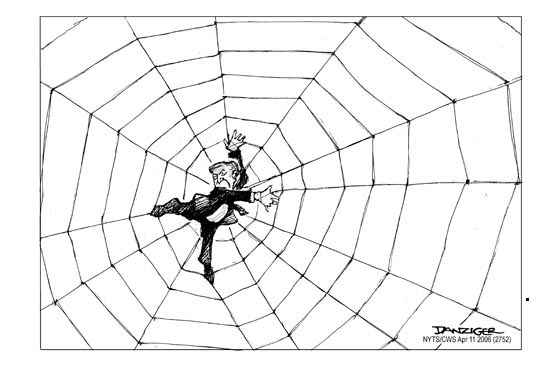
I've always liked Jeff Danziger's work. Sometimes his best work is richly detailed, and wryly scripted. Other times, he can let simplicity do the work. The Christian Science Monitor's loss is the LA Times' gain.

This week he has a nice, simple, clean take on Bush's overall response on the Iraq debacle, the immigration reform embarrassment, Plamegate--well, pretty much everything. Those who paid attention in high school will even detect a little Sir Walter Scott going on in there.

Thursday, April 13, 2006

Sir or madam: I dispute your fundamental premise!

As regular p3 readers already know, one of the things I find interesting about blogging--interesting like owning an ant farm or a tank of sea monkeys is interesting--is tracking the page someone was on immediately before they arrive at my place. A lot of times that turns up interesting slice-of-life Google searches.

But this one--which had me ranked #2 on the whole planet--is based on a foundational assumption that's just plain wrong.

That's all I can say: it's wrong.

I mean, one of those two people is a scowling woman who works for a government run by a whiny, duplicitous President.

And the other is a regular character on "24."

Wednesday, April 12, 2006

Reading: Krugman on wishful thinking

Paul Krugman has this to say to those among us who simply cannot believe that Bush and his cronies would have the foolishness--or the arrogance--or the whatever--to duplicate their ill-conceived, dishonestly promoted, and poorly executed war on Iraq, this time aiming at Iran:
"But he wouldn't do that." That sentiment is what made it possible for President Bush to stampede America into the Iraq war and to fend off hard questions about the reasons for that war until after the 2004 election. Many people just didn't want to believe that an American president would deliberately mislead the nation on matters of war and peace.

Now people with contacts in the administration and the military warn that Mr. Bush may be planning another war. The most alarming of the warnings come from Seymour Hersh, the veteran investigative journalist who broke the Abu Ghraib scandal. Writing in The New Yorker, Mr. Hersh suggests that administration officials believe that a bombing campaign could lead to desirable regime change in Iran - and that they refuse to rule out the use of tactical nuclear weapons.

"But he wouldn't do that," say people who think they're being sensible. Given what we now know about the origins of the Iraq war, however, discounting the possibility that Mr. Bush will start another ill-conceived and unnecessary war isn't sensible. It's wishful thinking.
Krugman's article is in the Readings list in the sidebar.

And the normally soft-spoken Josh Marshall has this to say about hopes that Bush and his cabal will someday, finally, see reason:
President Bush's dimwit megalomania seems to have survived the disaster of his Iraq adventure wholly intact.
"Dimwit megalomania." Spot on, Josh.

Tuesday, April 11, 2006

My dad had a saying:

"Some people hang their religion on a nail inside the door at the church when they leave, and pick it up again next Sunday morning."

With that in mind, check out this week's This Modern World.

The piety of George "Mock the Condemned" Bush seems almost heartfelt next to what DeLay parades around in.

Of course, Jesus's thing was to spend the most time with the people who most needed saving, but I kind of doubt that The Hammer would get the irony.

Sunday, April 9, 2006

Permission

Kevin at PK, quoting Digby, has thrown down the gauntlet:
If the president was willing to authorize leaking of national security information to reporters for political purposes, why should we believe he won't authorize warrantless wiretaps on Americans for political purposes?
It's true, and most of us blogging from this side of the dial have written about it already: Bush, Cheney, Rove, Gonzales, and the rest are going to keep pushing as hard as they can against the constitutional and political limits on presidential power.

By the time evidence comes to light that they've committed one particular offense against the Constitution, they're already on to the next offense.

Case in point: The Attorney General's most recent testimony before the Senate Judiciary committee, earlier this week:
In Gonzales's testimony today, he asserted that Bush has the authority to order wiretapping of solely domestic calls. [ . . . ] Given what we've found out about how this administration works, it's probably a fair bet that that we should interpret this as "Bush has ordered wiretapping of solely domestic calls."
It's tax week. As Oliver Wendell Holmes Jr. famously said, taxes are what we pay for civilized society. To pay your taxes this week and yet not get around to raising your voice about the offenses of the Bush administration is like saying "thank you" to someone who steals your wallet and burns your house down.

Pick up Kevin's challenge: Write your local paper and put them on notice, and yourself on the record. (Or contact your reps to Congress. Or do something to show we're awake out here--awake and outraged. Kevin offers more suggestions.)

Right now, Karl Rove has a little framed bit of needlepoint over his desk: "It's easier to get forgiveness than to get permission." Let's put an end to that.

Tell the truth. Fire the incompetents. (And 8 more!)

Maybe losing nasty presidential elections to George Bush is what it takes to make Democratic presidential candidates start talking like they're serious about leading.

On Friday, John Kerry pulled out the stops in attacking the incompetence and dishonesty of the Bush administration, and advancing a short and sweet 10-point plan.

The first two are in the post title, above. Here are the rest:
  • Find Osama bin Laden and secure our ports and our homeland.

  • Bring our troops home from Iraq.

  • Obey the law and protect our civil rights.

  • Support health care

  • Support education.

  • Support lobbying reform.

  • Support alternatives to oil.

  • Reduce the deficit.
The response of RNC spokeswoman Tracey Schmitt, reduced to attacking Kerry personally, since she had no remotely plausible rebuttal to any of his substantive points:
"John Kerry deserves credit for continuing to take himself so seriously, despite the fact that no one else does."
In fairness, it's a tough job for Schmitt, reduced to snark when the record clearly shows that the White House and the GOP-controlled Congress have ignored, torpedoed, defunded, privatized, or appointed boobs to manage every one of those points.

I'm not warming to the idea of a 2008 Kerry candidacy--which this speech was clearly testing the waters for--but no one's ever explained to me why you only have to tell the truth if you're trying to get nominated.

Friday, April 7, 2006

One teeny, tiny little thing (PDX DL recap)

The top five topics at last night's Drinking Liberally get-together:
#5: The Foxworth allegations--is there anyway we can get to the bottom of this without, you know, going completely to the bottom? Ee-yew.

#4: Wormer--he's a dead man! Marmalard--dead! DeLay--dead!

#3: Visiting dignitaries in our city this weekend: Kevin Phillips on Friday, and Jerome Armstrong and Markos Moulitsas Zuniga on Sunday and Monday.

#2: Voter-owned (but clearly not perfectly voter-controlled) elections: Is the glass half empty, or half full? (Side note: the California nurses, fresh from slapping Der Ah-nolt around last November, are now throwing their considerable clout behind public financing.)
And, from our home office at 9th and Hawthorne, the number one topic of discussion:
#1: Scooter Libby told Special Prosecutor Patrick Fitzgerald that Bush authorized leaking information from an NIE on Iraq for political purposes.
As the Skirt mused, in an email I didn't get to until after the meeting broke up:
wow, could this be it? ...could this be the one small thing that will get gwb impeached and thrown out of office?
Well, I'm not very optimistic myself about impeachment, on a lot of levels (two words: "President Cheney")--but even in these dark times, anything's possible. After all, in the end it was fewer than fifty words that brought down Nixon (June 23, 1972):
Haldeman: That the way to handle this now is for us to have Walters call Pat Gray and just say, "Stay the hell out of this...this is ah, business here we don't want you to go any further on it." That's not an unusual development,...

Nixon: Um huh.
And that, my friends, is a little thing we like to call "obstruction of justice." Once that tape was made public, showing Nixon planning to use the CIA to force the FBI off the scent, the game was all but over. (Of course, it was still more than 2 years from that conversation until Nixon's resignation.)

It doesn't seem as clear whether Bush would have broken the law by authorizing the Libby leak--and it's too soon to tell if he engaged in any other legal mischief connected with the NIE. And, of course, we can count on very little in the way of hard-nosed news media coverage this time around, and not even the whiff of a possibility of Watergate-style bipartisanship in Congress.

But--if the question is "after all the other things he's gotten away with, could one itty-bitty thing like this cost somebody the presidency?" the answer is definitely yes, it could.

So--now can we finally talk seriously about censure, at least?

Thursday, April 6, 2006

It's official: The evening network news is now completely irrelevant

Katie Couric, who is to "perky" as the Aegean Sea is to "wine dark"--the modifier is required in her contract--will be anchoring the CBS Evening News. A queen's ransom changed hands to bring this about.

Couric will take her seat as heir and successor to the "effervescent" Edward R. Murrow and the "bubbly" Walter Cronkhite--and, of course, Dan "The Pixie" Rather.

Here's a foretaste of what we can expect Couric to bring to the Evening News.

Expect ratings for dinner-hour reruns of "Friends" and "Everybody Loves Raymond" to skyrocket.

Wednesday, April 5, 2006

And the children shall lead them

This just in from Scholastic magazine:
In a nearly complete reversal from just two years ago, 80 percent of elementary school students say they do not want to be president of the United States.

In Scholastic magazine's 2004 poll, 75 percent of elementary students said they would like to hold the nation's top office. This year's results, however, found that 80 percent do not want the job.

Scholastic editors told The New York Daily News they have no idea why children's attitudes have changed so dramatically and doubt it's linked to the unpopularity of President George Bush.

"We are always surprised by things kids do and say," said Suzanne Freeman, executive editor of Scholastic News Online.

In a related Scholastic study, researchers found that a generation of American children do not want to be postal workers when they grow up.

According to Dr. Rudolph Schnaebel, principle researcher,
"We are simply stumped by the findings. In 1981, 79% of American grade schoolers responded favorably to the idea of becoming a postman/postwoman when they grew up. But by 1998 the number expressing a positive attitude about letter carriers had plummeted to 18%.

We have no idea why children's attitudes have changed so dramatically, although we doubt it's linked to the prime-time presence of buffoonish mailmen on 'Cheers' (1982-93) and 'Seinfeld' (1989-98)."
The characters of Cliff Claven ("Cheers") and Newman ("Seinfeld") were both nerdy, out-of-shape, emotionally stunted blowhards who were often the butt of the other characters' jokes, but Schaebel and his associates denied that this could have any relationship to the study's findings.

Even though the survey numbers took their worst dips in 1989-93 (7%, when both TV series were aired regularly in primetime) and again, beginning in 1998 (4%, when the series have both started being available several times weekly in syndication), the researchers dismiss the pattern as what statisticians call "a coincidence."

"Kids today," said Schnaebel. "Who can figure them, huh?"

(Thanks to Shakespeare's Sister.)

Failing upward: A quiz

(Courtesy of ThinkProgress.)

The numbers reflect the scale of their accomplishment:
  • Over 2300 American soldiers dead and a minimum of 18,000 wounded

  • Estimates of Iraqi civilian count somewhere in the five or six figure range

  • The cost to taxpayers at $270 billion and climbing by the second
But what's become of the braintrust that put the Iraq War together three (or four, or more) years ago? Test yourself. (Answers here.)

Here are the architects of Bush's War and their job titles back in 2003:
  • Elliot Abrams, Special Assistant to the President and Senior Director on the National Security Council for Near East and North African

  • Dan Bartlett, White House Communications Director

  • George Bush, President

  • Dick Cheney, Vice President

  • Mitch Daniels, Director of the Office of Management and Budget

  • Douglas Feith, Undersecretary of Defense for Policy

  • Stephen Hadley, Deputy National Security Advisor

  • Andrew Natsios, Administrator of the U.S. Agency for International Development

  • Richard Perle, Chairman of Defense Policy Board

  • Colin Powell, Secretary of State

  • Condoleezza Rice, National Security Advisor

  • Donald Rumsfeld, Secretary of Defense

  • Richard Tenet, Director, Central Intelligence Agency

  • Paul Wolfowitz, Deputy Secretary of Defense

  • David Wurmser, Special Assistant to John Bolton in the State Department

Now see if you can match the names with where they've landed today:
  • Promoted to head the World Bank in March 2005

  • Co-chairman of a project at Harvard University’s John F. Kennedy School of Government to write an academic book on how to fight terrorism

  • Promoted to National Security Advisor

  • Resident fellow at the American Enterprise Institute where he specializes in national security and defense issues

  • Promoted to deputy national security adviser in February of 2005

  • Promoted to Principal Deputy Assistant to the Vice President for National Security Affairs in charge of coordinating Middle East strategy

  • Currently teaching at Georgetown University’s Edmund A. Walsh’s School of Foreign Service as a Distinguished Professor in the Practice of Diplomacy and Advisor on International Development

  • Re-elected Vice President in 2004

  • Promoted to Counselor to the President on January 5, 2005, and is responsible for the formulation of policy and implementation of the President’s agenda

  • Re-elected President in 2004

  • Elected Governor of Indiana in 2004

  • Re-appointed Secretary of Defense in 2004
  • Awarded a Presidential Medal of Freedom in 2004

  • Poised to succeed Henry Kissinger in May as Chairman of the Eisenhower Fellowship Program at the City College of New York

  • Promoted to Secretary of State in 2004, and is being widely-mentioned as a possible presidential candidate

You can begin to see why Michael "Heck of a Job" Brown is feeling badly used--with his track record of failure at FEMA, he should at least have a cushy job at a right-wing think-tank somewhere, wouldn't you think?

Bush has surrounded himself with--and rewarded, or at least protected--people who haven't a clue how to fix the mess they've made in Iraq. Worse, they haven't the desire. Bush wasn't kidding when he said he figured it was the next president's problem to clean up his mess.

Tuesday, April 4, 2006

Net neutrality: Unpleasant update

The big carriers--the cable and telco operators who never wanted the internet in its present form, where services, content, and user voices can spring up like wildflowers--are prepping another assault on net neutrality.

Here's an excerpt from Rep. Ed Markey's opening statement on the telecommunications bill making its way through the House:
Tens of millions of Americans and hundreds of thousands of American businesses use and rely upon the Internet every day. In addition to its vital economic role, the Internet is also an unparalleled vehicle for open communications by non-commercial users, for religious speech, for civic involvement, and our First Amendment freedoms.

The reason why the Internet is so revered as a medium and prized as an engine for innovation and entrepreneurial entry is that it is open to all comers. It is this very openness that allows Americans to access the content and services they want, and not just the content and services that some broadband baron has chosen for them. The fundamental truth about the Internet is that no one owns it. The Internet is the type of disruptive technology that Josef Schumpeter talked about as being indispensable to our capitalist system. Schumpeter said that "without innovation, no entrepreneurs, without entrepreneurial achievement, no capitalist returns."

Yet the Internet is at endangered because of the misguided provisions of the bill before us, which put at grave risk the Internet as an engine of innovation, job creation, and economic growth. The bill permits the imposition of new fees, or "broadband bottleneck taxes" for Internet sites to access high-bandwidth consumers. This will stifle openness, endanger our global competitiveness, and warp the web into a tiered Internet of bandwidth haves and have-nots. It is the introduction of creeping Internet protectionism into the free and open World Wide Web.
Read the rest of Markey's statement for a fuller list of the consumer and civic horrors--and the corporate reach-arounds--built into this newiest piece of legislation. Common Cause has a good information site going, too.

As MyDD writes, "The right-wing used to be against regulation; as it turns out, they just want to privatize who gets to regulate."

"Upload the drive to my socket. Access code 5J55J."

Last night, as I watched Chloe O'Brian crankily data-mining her way through untold terabytes of information to save Jack Bauer's bacon yet again, I found myself thinking about Google. Google is sort of the poor man's Chloe O'Brian--without the attitude that has endeared her to "24" fans.

A lot of people out there have latched onto Google--or the idea of Google--as the answer to their problems.
  • The Justice Department argued that court-enforced access to Google's records of individual searches was necessary to enforcement of the Child Online Pornography Act. (The court disagreed.)

  • "Certain organs of US intelligence," as a John LeCarre character might put it, long for the day when they have Google-like access to their own case-files and data.

  • University faculty hope that Google and similar search engines can give them the edge in the two thousand year-long war against student plagiarism.
And yet, as sophisticated as Google is, there are times when it's clearly not much more than a way to draw surprisingly mistaken conclusions from an amazing amount of information at astonishingly high speed. An accomplishment of sorts, but still . . . .

I've written before about the odd routes by which Google has led some people to p3. I found another delightful example this morning. I guess I'm proud to think that p3 comes up first on a search for "portland whorehouse riots," but as you'll see it's a false-positive. The hapless searcher may have found what they were looking for farther down the results page, in Ruth Rosen's The Lost Sisterhood, although if so it means they were looking for Portland OR's namesake in Maine.

(I wasn't able to find the archived story from that tantalizing KATU link about halfway down the results page; if anyone can get to it, please put the link in the comments section. Thanks.)

One final thing to notice about Google, though--even if you query it about something as dubious as Portland whorehouse riots, the first thing it does is offer help with maps and street addresses. I'm sure that, if Jack had phoned Chloe about a whorehouse riot, she would have immediately downloaded the maps to his PDA.

Google: The poor man's Chloe O'Brian.

Monday, April 3, 2006

If I didn't have a Hammer

O be still, my beating heart:

Does the former Congressional Majority Leader have a bumper sticker on his way?

We can only hope.

Serves me right, though, for watching "Prison Break" and "24" back-to-back tonight: Carla at PK totally blew past me on this one.

Click!

The Trib had a story last week about the small but growing classroom presence TAG ("teaching with acoustical guidance") teaching--or "clicker training," as many pet owners know it.
The theory behind TAG and clicker training methods is similar: Break a behavior down into simple steps, and reward the student for right moves with a click (and a treat, if your student is a dog).

"It’s great for isolating problems," Rodriguez says.

Using a clicking noise in teaching is more effective than verbal reinforcement, according to Keri Gorman, a nationally certified TAGteach instructor. Gorman teaches TAG seminars in the Northwest and will start a five-week-long TAG class through Portland Community College next month.

"The clicking sound works faster in the brain and creates a muscle memory," she says.

It also sounds the same every time, whereas people use a different inflection whenever they say "Thank you" or "Good job." The message won’t get mixed: A click means the student did something right. Silence means "Try again."

Baldwin has discovered the difference firsthand at the climbing gym.

"Hearing the click doesn’t take your mind out of the game," he says, which is important when he’s thinking about the next handhold to grab.

As with clicker training for animals, TAGteach is based on positive reinforcement. When a teacher breaks down a movement or behavior into simple steps, it sets the student up for success.
I wish them better success with rock-climbing teenagers than I've had with a cranky parrot.

Before getting into the heart of the story, I suppose I should admit that the idea of clicker-training in the classroom, for humans, just sounds . . . not-right to me. But then most of my classroom experience was in professing, a communication activity whose assumptions couldn't be much farther removed from behavior training. Had I been a fourth-grade teacher, I might well look at the whole problem differently today.

Back to Pardoe, though. It's a general rule of thumb that parrots, in general, are on an intelligence level roughly with human two- or three-year-olds, both in pattern-recognition and puzzle-solving abilities, and in neediness and ME!-centeredness. That pretty much fits. He's a big believer in rituals and routines. Certain things--e.g., having breakfast while I read the morning paper--have to be done exactly the same way every morning, or he gets annoyed. Since I'm much the same way, I can't say I fault him for this.

To the extent that I've taught him "tricks," it's usually that I've managed to encourage habits he's already got.

He's pretty vocal, but he's not from a breed that learns to "talk" as often as some other breeds. As one new-agey neighbor remarked, "he's really got quite an aura about him." (Yes, I suppose he does, although the charm of his aura wore off on her by the second time she parrot-sat for him while I was away. I could have told her--warned her about "aura fatigue"--but then she probably wouldn't even have parrot-sat that second time. Like other people's children, part of the delight of parrots is if you know someone else has to take them home and deal with them.)

Pardoe has several annoying habits--unsocial rituals--that I'd love to put a stop to. Squawking when I'm trying to talk on the phone--or even when he hears the phone beep as I press "talk" or try to enter numbers--is a big one on this list. I know enough to know that he didn't just decide to be a little horse's ass about this--somehow, I've unwittingly encouraged him. As anyone who remembers the BBC reality-TV precursor and 1980s cult classic "Training Dogs the Woodhouse Way" knows, fifty percent of the task of training Pardoe would involve training me (La Woodhouse would probably say it's closer to eighty or ninety percent).

A friend claims, "you never break a habit; you just substitute a new one for an old one." Probably some truth to that, including in the present case. In other words, teaching--convincing?--Pardoe to do nothing when I answer the phone has a nice zen-like sound to it, but isn't really workable. He's probably always going to react when the phone rings. The trick is to get him to react in a way that doesn't annoy me--to hop up on his perch, or do the White Man's Overbite Dance (long story; don't ask), or whatever.

Initial do-it-yourself attempts to improve his behavior haven't really worked. Here, for example, is the cover of one bird-training book I got.


Notice that much of the right edge of the cover has been chewed away.

So I bought the clicker training kit and set to work. Clicker training pairs the sound of the click with the giving of a treat for correct (or approximately correct) behavior. This works much less efficiently with Pardoe than it would with a dog, because Pardoe doesn't "wolf" his food. Give him the tiniest bit of a treat and he'll still take forever to chew it and nibble it a little at a time until, by the time he's swallowed it, we've both forgotten what we were trying to accomplish a few minutes earlier.

And if the point is to improve his behavior when I'm on the phone, that brings up added problems. I can't simply hold a dead phone up to my ear and expect him to fall for it, even if I start speaking. If he doesn't hear the phone ring or the touchtone buttons beep, he's not fooled for a minute. Which means that, to get him to a teachable moment, I would have to call myself from my cell phone or convince a friend to call me. My friends, if you can imagine this, aren't as interested in outwitting the bird as I am, so it's hard to motivate them to play Stump the Parrot.

The whole thing makes teaching rock-climbers sound easier.

Of course, with rock-climbers and dogs, there's always that bottom-line mammalian fellow-feeling that you just don't get with a raptor-descended parrot. Remember the moment in "Jurassic Park," when the two raptors have cornered the children in the kitchen? "We're safe in here," think the kids, "because they won't know how to work a door latch." And outside the door, we see the raptors studying the handle . . . studying . . . studying . . . . Occasionally I'll catch Pardoe, in an unguarded moment, watching me like that. Studying. Measuring. For lord knows what.

Sunday, April 2, 2006

Reading: Oil, fundamentalism, and debt

Kevin Philips has a must-read in today's Post:
Since the election of 2000 and especially that of 2004, three pillars have become central: the oil-national security complex, with its pervasive interests; the religious right, with its doctrinal imperatives and massive electorate; and the debt-driven financial sector, which extends far beyond the old symbolism of Wall Street.

President Bush has promoted these alignments, interest groups and their underpinning values. His family, over multiple generations, has been linked to a politics that conjoined finance, national security and oil. In recent decades, the Bushes have added close ties to evangelical and fundamentalist power brokers of many persuasions.

Over a quarter-century of Bush presidencies and vice presidencies, the Republican Party has slowly become the vehicle of all three interests -- a fusion of petroleum-defined national security; a crusading, simplistic Christianity; and a reckless credit-feeding financial complex. The three are increasingly allied in commitment to Republican politics.
Of course, viewed this way, it's not terribly surprising that John McCain--right on (campaign) schedule--has kissed and made up with Jerry Falwell. In the national Republican Party that two generations of Bush have created (only once since 1980 has there not been a Bush on the GOP ticket as presidential or vice-presidential candidate), there's simply no alternative for anyone who wants the nomination.

Well, he could leave the Republican Party, of course--but he's clearly got no intention of doing that (and where would he go, anyway? The Dems can get all dewy-eyed about him, but at the end of the day they'd no more want him than he would want them. One hopes not, anyway.) Or he could start the long struggle to win back his own party from the forces that control it now--but that's obviously going to involve a lot more "straight talk" than McCain is up for. No, I'd say he's comfortable with things as they are.

Philips' article is going on the Readings list in the sidebar.

Well, that's certainly a relief

Good news: The Reverend Jerry Falwell is no longer "an agent of intolerance."

That's right--the man who gave us, among many such moments, this classic bit of hate-thy-neighbor following the attacks on the World Trade Center and the Pentagon in 2001--
"I really believe that the pagans, and the abortionists, and the feminists, and the gays and the lesbians who are actively trying to make that an alternative lifestyle, the ACLU, People For the American Way, all of them who have tried to secularize America. I point the finger in their face and say 'you helped this happen.'"
--no longer need be kept at arm's length from the Republican party (as if he ever had been).

And we know this because John McCain, a man who needs Falwell to become president, said so this morning. So that should pretty much settle that.

At DailyKOS, georgia10 has McCain's number:
What we saw in that interview was the death of McCain the Maverick, and the birth of McCain the Chameleon.
Damn straight. McCain made it clear: Time to kiss and make up with the Moral Majority "because they’re so active and their followers are." What they stand for may be just as unappetizing as ever, but remember how many volunteers and donors they represent for the 2008 primary!

It's past time to wean America--especially Democrats, Independents, moderate Republicans, and the news media-- of that McCain-the-Maverick dream. Over at the White House, the new byword is "Let Bush Be Bush (since nothing else is working either); I say, let the word also go forth: Let McCain Be McCain--

The Chameleon.

(Update: AmericaBlog has a perfectly reasonable follow-up question.)

Saturday, April 1, 2006

Helen Thomas: Truth babe

I blogged about Thomas putting the screws to Scottie "Flopsweat" McClellan last week. Juicy excerpt:
Q The memo says he wanted a war, basically that he was determined, and there were no weapons found.

MR. McCLELLAN: No, Helen, that's not an accurate assessment, and you know it. Because you covered --

Q Is this memo wrong?
But that was really little more than a minor dust-up, compared to the major confrontation she had with Bush at a press conference about a week earlier. Even juicier excerpt:
Q I'd like to ask you, Mr. President, your decision to invade Iraq has caused the deaths of thousands of Americans and Iraqis, wounds of Americans and Iraqis for a lifetime. Every reason given, publicly at least, has turned out not to be true. My question is, why did you really want to go to war? From the moment you stepped into the White House, from your Cabinet -- your Cabinet officers, intelligence people, and so forth -- what was your real reason? You have said it wasn't oil -- quest for oil, it hasn't been Israel, or anything else. What was it?

THE PRESIDENT: I think your premise -- in all due respect to your question and to you as a lifelong journalist -- is that -- I didn't want war. To assume I wanted war is just flat wrong, Helen, in all due respect --

Q Everything --

THE PRESIDENT: Hold on for a second, please.

Q -- everything I've heard --

THE PRESIDENT: Excuse me, excuse me. No President wants war. Everything you may have heard is that, but it's just simply not true. My attitude about the defense of this country changed on September the 11th. We -- when we got attacked, I vowed then and there to use every asset at my disposal to protect the American people. Our foreign policy changed on that day, Helen. You know, we used to think we were secure because of oceans and previous diplomacy. But we realized on September the 11th, 2001, that killers could destroy innocent life. And I'm never going to forget it. And I'm never going to forget the vow I made to the American people that we will do everything in our power to protect our people.

Part of that meant to make sure that we didn't allow people to provide safe haven to an enemy. And that's why I went into Iraq -- hold on for a second --

Q They didn't do anything to you, or to our country.

THE PRESIDENT: Look -- excuse me for a second, please. Excuse me for a second. They did. The Taliban provided safe haven for al Qaeda. That's where al Qaeda trained --

Q I'm talking about Iraq --
Thomas doesn't get voted Miss Congenality in Bush's Washington for publicly reminding Bush of the difference between Afghanistan and Iraq. For every pundit who applauded her performance, one or two more attacked her behavior as "unprofessional" or "improper."

So when she takes the President on, Thomas doesn't expect roses. Which is what made it so cool that she received 108 dozen roses (yes, the number's correct) from an internet campaign organized by Democratic activists:


(photo credit: The Hill)

The full story is here. (Hat tip, as well, to AmericaBlog for spreading the word.) Thomas sent this reply to the senders:
"Blessed are the peacemakers. The bounty of beautiful roses from such wonderful people has lifted my heart and will remain in my memory for the rest of my life. Thank you for caring that others may live."
Class act.

Snookered, as my dad would say

I got totally nailed on this one.

Wait till next year. "Dish best served cold," and all that.

Sobering thought for the day

The first of April is the day we remember what we are the other 364 days of the year.

- Mark Twain

Friday, March 31, 2006

Good, evil, and the value of a lovely baritone

Over at Preemptive Karma, I've got a post up about--more or less--why life can be easier if you've never had The Worst Man in the World disarm you by giving you one of his silly nicknames.

Check it out, and bring your pitch pipe.

Which part of "no" don't you understand?

The right of the people to be secure in their persons, houses, papers, and effects, against unreasonable searches and seizures, shall not be violated, and no Warrants shall issue, but upon probable cause, supported by Oath or affirmation, and particularly describing the place to be searched, and the persons or things to be seized.
While we're letting it all percolate, here are some readings:

Thursday, March 30, 2006

Subliminal messages from The Economist?

I like The Economist. It has really good writing, and, although it's obscenely expensive, in the last few years it's been a good way to escape the narrowness and GOP-talking-point-drivenness of most American news media.

Also--let's be candid--I like them because they're increasingly antagonistic toward the Bush administration, which shouldn't be surprising from a publication that describes its mission as to "take part in a severe contest between intelligence, which presses forward, and an unworthy, timid ignorance obstructing our progress." (Not surprising, at least, from a publication that actually means talk like that. Are you listening, Washington Post?)

Case in point: From their weekly email news summary in my inbox this morning, here's their blurb about Andrew Card's resignation:


Now Card was the Chief of Staff for five years. He surely participated in hundreds and hundreds of photo-ops with the President. And of that photographic trove, there must be a lot of photos of him appearing, metaphorically, to have the President's ear.

But look at the one they picked. In case it's cropped too much to recognize, here's another photograph, slightly different angle, from the same moment:


Yes, it's the moment--for many, the defining one of the Bush presidency--on the morning of September 11, 2001, when Card temporarily interrupted Bush's reading of The Pet Goat to a Florida elementary school class, to inform him that the US was under attack--after which, Bush returned to reading to the class for another five minutes.

All the available photos of Card and Bush, and they went for that one. Hmm.

But then, as I mentioned, The Economist has gone increasingly sour on All Things Bush; it supported his 2000 campaign, but in 2004 it supported Kerry. And it's called for the resignation of Rumsfeld. And, one could argue, the souring began pretty early on; here's a web ad that I screen-captured in mid-October 2000 (sorry about the image quality, but in 2000 I didn't know what a blog even was):


When I first dug this image out on my hard drive this evening, I thought for a moment that I'd found yet another "Pet Goat" photo, although the time-stamp on the file indicates we're looking at Candidate Bush, not President Bush. And yet, once again, The Economist was running a photo in which he's evidently reading a children's book. And that time, of course, it's in a context that's evidently not even trying to be fair-minded. (Or at least certainly it doesn't read that way to me.)

Kind of makes you wonder how much they pay--or if they even have to pay--their photo editors.

Oregon angle:

The Pet Goat is part of a reading mastery series co-authored by Siegfried (Zig) Engelmann, professor of education at U of O. (The pet goat in question, according to comments at a press conference, is also "from a farm in rural Oregon.")

Censure motion watch

The Nation's blog has this preview of tomorrow's Judiciary Committee hearings on the Feingold censure resolution:
Congressional Democrats have pretty much abandoned their Constitutionally- mandated responsibility to check and balance the excesses to the executive branch – so much so that the one Democrat who seeks to hold President Bush to account for ordering the warrantless wiretapping of American's telephone conversations accuses for party's leaders of "cowering."

So where is Wisconsin Democrat Russ Feingold finding support?

Among Republicans. Or, more precisely, among prominent alumni of past Republican administrations.

When the Senate Judiciary Committee convenes as extraordinary session on Friday to consider the Feingold's motion to censure the president for ordering federal agencies to engage in eavesdropping in violation of the Foreign Intelligence Surveillance Act's requirement that judicial approval be obtained for wiretaps of Americans in the United States, the dissenting senator will call two witnesses.

Making arguments about the extreme seriousness of the warrantless wiretapping issue -- and the need for a Congressional response -- will be noted constitutional lawyer Bruce Fein, who served in President Ronald Reagan's Department of Justice as Deputy Attorney General, and author and legal commentator John Dean, who served at Richard Nixon's White House counsel before breaking with the president to reveal the high crimes and misdemeanors of the Watergate era.
Well, I suppose that survivors of the Nixon and Reagan administrations would be in a position to know high crimes and misdemeanors when they see them.

What will it take for the Dems to make that all-important evolutionary leap from pre-vertebrate to vertebrate? How far will Bush have to cross the constitutional line before they realize it's their duty to take him on? (Or, for the more cynical, how low will Bush's numbers have to sink before the Dems realize it's safe to take him on?)

Georgia10 at DailyKOS adds this comment:
While Democrats still remain hesitant to back Feingold's measure, opting instead to wait for Godot an "investigation," their stance will look more pathetic than prudent as members of past Republican administrations testify to the gravity of the President's crimes.

Wednesday, March 29, 2006

Moment of Truth for Uncouth Bluths

Q: How close to dead can a TV series get without actually dying?

A: Unbelievably close, apparently.

Although FOX hasn't officially cancelled Arrested Development, and probably won't until May, now it looks like the one safe harbor for the series--Showtime--isn't going to follow through on its plans to pick up the series.

So, to be technically accurate, even though it has nowhere to leap and there are no more miracles in sight, AD hasn't been cancelled--but if it still has any of your CDs or clothes, you should probably use your spare key to let yourself in and get them before someone else strips the place.

Still, the cast managed to be philosophical:
Everyone involved in the series benefited, [series star Justin] Bateman said, including Fox. "At least they had a presence at the Emmys, which was new for them."
(Correction: Pleased with the rhyming scheme in our Variety spoof title, we inexplicably got the Bluth family name wrong in our previous post. p3 deeply, deeply regrets the error. The title for this post isn't as good as the other one, either, and p3 is pretty bummed about that, too.)

Creepy analogy of the day

Back to the resignation of Andy Card and his replacement by Josh Bolten--or as some like to call it, the replacement of a former auto industry lobbyist by the fellow who ran the Office of Management and Budget while our national debt soared to $9 trillion (yes, with a "t") without feeling the need to pull the emergency brake cord:

To those blithe hopefuls thinking that this change begins the introduction of "fresh blood" into the White House leadership team, p3 special correspondent Sam observed last night, "that's like getting a transfusion from Keith Richards."

Ee-yew.

Okay--let's all break, take a shower and burn our clothes, and meet back here later.

Well, who the hell saw this coming?

The results are in from an AP-Ipsos poll on Americans' attitudes toward profanity. Among the findings:
[P]eople were more likely to be bothered by profanity as their age increases.
So. Fill in the blanks:
_________ H. Tapdancing __________! I'm _________, for _________'s sake! How the _________ do those tiny-_________ pieces of __________ expect me to express myself, anyway? Bunch of little _______ .

_________.

Specter cave-in countdown: Update

Last Sunday I predicted that Arlen Specter would find some signature way to torpedo Russ Feingold's censure resolution with the Judiciary Committee takes it up on Friday--this after insisting that Bush was "plain wrong" to claim he could authorize warrentless surveilance of American citizens.

(Okay, "predicted" is probably a little too self-aggrandizing, since Specter's pattern in such matters is so well-known. Let's say "pointed out" instead.)

Anyway, semantic haggling aside, the first tremblings of the Specter cave-in may have already been detected. Here's the first half of the story, at National Review Online a few hours ago:
Specter also discussed a conflict with Judiciary Committee Democratic Sen. Russell Feingold over Feingold's call to censure President Bush. Specter has scheduled a committee hearing for Friday on the censure resolution, but he said Feingold has asked that it be delayed.

"He says he's going to be someplace else," Specter said of Feingold. "I don't know if I can have a hearing without him, and my instinct is, I'm offering him a hearing, and if he doesn't take it, he's not going to have a hearing."
But over at firedoglake they've got Feingold's blunt denial that he's asked for any postponement, in which he also raises the question of whether it might in fact be Specter who's looking for a way to get out of holding the hearing on Friday.

Stay tuned.

Tuesday, March 28, 2006

Variety: Blum Boom Assumed Doomed

Arrested Development inches closer to death, yet still manages not to be completely dead.

Inoculation

In 2008, when Gordon Smith runs for re-election to the US Senate, he will briefly rediscover his deep and abiding concern for The Little Guy.

Don't believe a word of it.

Card shuffled out of the deck

Many observers are wondering if the resignation of Andy Card as White House Chief of Staff is the beginning of the hoped-for--or at least expected--shakeup of personnel on the failing president's team. For example, the Financial Times writes:
The resignation of Mr Card – who served for more than five years in the position that Mr Bush has dubbed "the Big One," - follows months of speculation about a shake-up. In a sign of the growing unease about the administration, these calls have increasingly come from Bush loyalists such as Norm Coleman, Republican senator for Minnesota, who called for a new team with "fresh political antenna." Last week Mr Bush, was again asked about changes, but noted, "Well, I’m not going to announce it now."
Ritual purification would seem to be the order of the day, in an administration so thoroughly tainted by grand juries, indictments, a dismal second-term slate of domestic and foreign policy accomplishments, and ever-sinking poll numbers. So perhaps Card's departure will provide satisfying political theater for some.

But for anyone expecting that this will produce any noticeable change in the strategy or tactics of Team Bush--forget it. Replacing Card with Josh Bolten isn't bringing James Baker in to rescue Reagan's second term; it's just more of the same. As the Financial Times continues:
In office, Mr Bush has favoured loyalists and old friends over intellectual thinkers or policy mavens in making his most senior appointments, Most of his most senior aides, from Mr Card, who also served for Mr Bush’s father, to Karl Rove, his deputy chief of staff, have known him for decades. Mr Bolten is in the same mould as Mr Card. He worked for Mr Bush’s father for four years and was recently head of the budget office.
The rot at the top isn't just about the individuals holding this or that position in the Bush administration; it's every bit as much about the policies the administration is pursuing. Make a few minor changes in personnel but keep the policies in place, and nothing will get better. And the policies won't change so long as Rove, Rumsfeld, and Cheney stay in place. Bush has demonstrated that it'll take dynamite to get Rove and Rummy out, even though the former has leaked classified information and the latter is the architect of the military disaster that is Operation Iraqi Freedom.

And we know Bush isn't getting rid of Cheney, because Cheney said so.

Abrupt resignation seems to run neck-and-neck with scandal in the second-term Bush administration--sometimes it's scandal by a nose, and other times the resignation just beats scandal to the wire, but it's invariably a close race. (Although John Dickerson at Slate has developed a more complex system for tracking the Bush departures.)

So here's my prediction: Expect nasty news about Andy Card to surface in the next few weeks. Maybe this. Maybe something else.

Monday, March 27, 2006

US Constitution: Do Not Shred!

Christy Hardin Smith at firedoglake has point on a major grassroots initiative, designed to make it impossible for the Republican-controlled and Democratic-abetted Congress to continue acting as if rejection of the Bush administration's dishonesty and lawbreaking is a minority opinion among Americans, a minority they can safely continue to ignore.

It isn't.

I urge you to take a few minutes and participate. It has all the things I like in an action like this: Genuine grassroots action (not astroturf) and some sly wit. (You'll see.)

And as fond as I am of the instant gratification of a phone call or email, the sheer physical presence of those faxes as they mount up in those In Baskets is going to be a statement all its own.

Just do it. Don't fret that you aren't an expert at writing to Senators. Just keep it short and sweet and from the heart. Complaining that you don't know what to say to your Senator is like saying you can't go to the anti-war rally because you don't have a thing to wear. Your righteous patriotic anger is your ticket in.

It's already started: The fax machines on the Hill are going to burn through the paper and toner in the next day or two.