Tuesday, January 31, 2006

Civil liberties pop quiz:

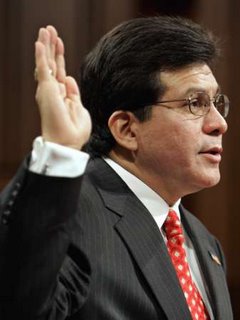
If you think you know how many potential candidates for US Senate, present as an invited guest of a Member of Congress, were removed from the audience of the State of the Union speech tonight, placed in handcuffs, and charged by the Capitol Police with unlawful conduct, raise your hand.


Not so fast, Mr. Gonzales!

Attytood puts this moment in its proper perspective:
Did you know that in 1971, the Supreme Court said it was unconstitutional to arrest a man who wore a "F--- the Draft" T-shirt into the courthouse? (Cohen v. California, you can look it up.) So now Alito's on the court for 45 minutes and your civil liberties are already going down the toilet. You were warned.
(Thanks, Liz!)

Abu Ghraib: "Father of the Raven"

I'm writing this as Bush delivers his sixth State of the Union Address. In January 2001, I made it a few minutes through his first inaugural and bailed, largely because I simply couldn't stand that squinty-eyed smirk. Not so soon after Bush v Gore. Later, when he began to add condescending explanations of the obvious to his small bag of oratorical tricks, I stopped even trying. (You know the bit of shtick I mean: He uses a word any seventh-grader knows, then leans forward with a pitying smile, makes a chopping movement with his left hand, and smugly explains to the questioner what the word means. One imagines he's explaining it just as it was just explained to him a few minutes before air time; he's got that "It Pays to Increase Your Word Power" glow on his face.)

I used to be a great one for watching Inaugural addresses and State of the Union speeches and suchlike. Probably goes all the way back to the 1971 SOTU (long before we were calling them SOTUs, in fact). My pals and I were assigned to watch it by our high school econ teacher, and today I still remember bits and pieces of the six "Great Goals" Nixon enunciated in that speech: "The wealthiest nation in the world should be the healthiest nation in the world." And: We must "preserve and enhance our natural environment." Interesting for the idea of a Republican president who gave a crap about health care and who wasn't the mortal enemy of the environment, but otherwise, just a couple of little sticky-notes clinging to the cardigan sweater of my brain.

Then, for many years, I taught courses in political rhetoric and public address, so I was taping them for class use. This was back in the day when conventions were, if no longer the object of gavel-to-gavel coverage, at least something more than the unwatched and unwatchable pageant that the networks rightly ignore today. (Remember Ted Kennedy, on the second or third night of the 1988 Democratic convention, leading a gleeful crowd in the chant "Where was George? Where was George?")

But that was over a long time ago. The last State of the Union I watched with any enjoyment was Clinton's final one, in 2000. He was obviously having a great time, knowing he could no longer set a legislative agenda but nevertheless firing progressive policy ideas out there, one after another. I remember watching it at the time, and thinking: You know, he'll never have this much fun again for the rest of his life.

No doubt about it, though; this has been a tough week for the Forces of Light. The Senate Republicans confirmed Bush's nomination of "Strip Search Sammy" Alito to the Supreme Court today, a mathematical inevitability despite (or, arguably, because of) the hastily planned Democratic filibuster attempt. Americans can go to sleep tonight in the comfort of knowing that, by 2008, jurisprudentially speaking, America will be firmly re-planted in the 1920s, if not indeed the 1720s.

And tonight, Bush gets another chance to change the subject from Republican corruption, Plamegate, the Iraq debacle, the Palestine debacle, the Iran debacle, the hollowed-out economy--and, of course, his own dismal job approval numbers--by thumping another "reform" designed to undermine another popular body of liberal/progressive legislation (this time, it's health care) and reminding us that everything changed since 9/11.

While I'm sure Junior enjoys looking down on the Congress and the Supreme Court tonight from his podium tonight--an architectural metaphor that surely gratifies his "Sun King" ambitions--the idea that he has to continue the fiction of actually needing either of the other two branches of government to carry out his policies is probably galling to him. I imagine he'd rather step out on a balcony somewhere, wearing Ray Bans and a Michael Jackson-esque military costume, and intone, "Arise, my people, and look upon me."

So the Alito confirmation, ghastly as its consequences will be for our country for a generation, is a done deal. And the SOTU is little more than kabuki theater. (And it's only Tuesday. Is this a great country, or what?)

I'm trying to find comfort in the fact that Attorney General Gonzales will shortly have to account to the Senate Judiciary Committee for having--apparently--lied through his capped teeth about the NSA wiretap program to Committee during his confirmation hearings last winter. (The head of the NSA may also have some 'splainin' to do.) Russ Feingold has called Gonzales out on it already.
With a little luck, Gonzales, the chipmunk-cheeked Albert Speer of Bush's New Reich, may also one day have to account for having laid the theoretical groundwork for America's emergence in the 21st century as a torture state. I've already written about the special way that power corrupts within the Bush administration; let's take a moment to consider how that poison flows throughout the system of our nation. This is from "Judgment Days: Lessons from the Abu Ghraib courts-martial," by JoAnn Wypijewski, in the February, 2006, Harper's Magazine (emphasis added):
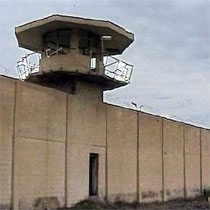
When the Abu Ghraib scandal broke, people wondered, Why did they take pictures? During jury selections at Fort Hood, at least one battle-creased sergeant would always abandon euphemism and say, If you're going to do something like that, why would you photograph it?  The simplest explanation is the best. They took pictures because they could. Soldiers in Iraq take pictures like crazy, especially, I was told, where signs instruct them not to. They take pictures because they're bored or want souvenirs. They take pictures of people they arrest (an abrogation of the Geneva Conventions), of fighters they kill (ditto), of bodies they desecrate (a war crime). They email them home or send them with photos of their wives to a porno website or string them together and add sound to make commemorative videos.
And there you have it: Limitless power finds what's worst in you and magnifies it. Gonzales provides the theory of torture, Cheney the enforcement, Rumsfeld the supervision, Bush the front--and the Army Reservists eventually tried at Fort Hood moved it from theory to practice. It's a surprisingly straight line from the paneled Executive Branch offices in DC to the stinking, sweaty Iraqi dungeons.

Monday, January 30, 2006

Last word

In New Jersey, there are guys who join the Mob just so that their mothers won't think they work for a medical insurance company.

If I'd thought of that line during the hour I spent on hold this morning, I'd have used it then, but I didn't, so I'm using it now.

"We're usually called 'Professor'"

While I'm working on getting other things together, here's a noteworthy entry from Sunday's Doonesbury.
While we're on the subject: The running thread--very dark thread--about B.D. and his post-Iraq, post-amputation disorders has been fascinating. There are precious few on the news and op-ed pages who are touching issues like this; to find it on the comics page is astonishing.

Sunday, January 29, 2006

Truth and The Oregonian (but in a good way)

"And what is truth, Phaedrus, and what is not truth -- need we ask anyone to tell us these things?"

Well, perhaps yes.

By coincidence or cosmic design, The Big O today featured two interesting pieces in two different sections on the shaky status that respect for the truth seems to enjoy at this moment.

Tip of the hat to Joel for spotting the truth trend in the making.

Thursday, January 26, 2006

Parade envy

One of the dumbest, most mean-spirited little screeds ever to appear on the op-ed page of an otherwise respectable newspaper popped up recently down at the LA Times. If I link to it, whatever little bit of extra traffic that might get them could be construed by them as encouragement, however slight, to engage in more of this kind of behavior, so I'll just give you this little squib, quoted by Steve Gilliard at The News Blog:
I DON'T SUPPORT our troops. This is a particularly difficult opinion to have, especially if you are the kind of person who likes to put bumper stickers on his car. Supporting the troops is a position that even Calvin is unwilling to urinate on.

I'm sure I'd like the troops. They seem gutsy, young and up for anything. If you're wandering into a recruiter's office and signing up for eight years of unknown danger, I want to hang with you in Vegas.

And I've got no problem with other people — the ones who were for the Iraq war — supporting the troops. If you think invading Iraq was a good idea, then by all means, support away. Load up on those patriotic magnets and bracelets and other trinkets the Chinese are making money off of.

But I'm not for the war. And being against the war and saying you support the troops is one of the wussiest positions the pacifists have ever taken — and they're wussy by definition. It's as if the one lesson they took away from Vietnam wasn't to avoid foreign conflicts with no pressing national interest but to remember to throw a parade afterward.
And it continues that way for about another 500 words. Steve Gilliard then goes on to do something I'm not prepared to do myself: He takes the author, Joel Stein, seriously enough to reply:
Why would you support the troops? Because, for many of us, they are our families. They didn't choose to go to Iraq and no one asked them about Afghanistan. The deserve our support, because like firemen and police officers, they do a job for the rest of us that we ask them to do. It is our collective fault when they are misused. You cannot assign away your responsibility all that easily.

Second, they don't just fight for the people who supported the war. If Mr. Stein wasn't a smug fuck, he'd read Stars and Stripes and see American soldiers, in Iraq, oppose this war. They serve because they have to, but they didn't stop thinking.
Actually, when I shared this tidbit with longtime reader/correspondent James the Elder, he fired back a note in much the same vein:
Stein is quite the fellow, isn't he? Of course, he is the perfect rep for many of the members of the administration and for that matter the American public. Talk about the love of the troops but don't really pay them an appropriate salary. A cop gets more than a grunt. Cut VA bennies, especially if you are wounded or better yet if you can't see the wound. Don't let them move into your neighborhood.

Sorry, I just find that attitude very crappy. Makes me think of Dick "I had other priorities" Cheney. On the other hand, Stein is, unlike the other guys, being out front about the whole thing. That is a little different. I suppose it is tough when you have a life of privilege and just don't understand when others don't.
Can't really fault either one of them for the substance of their replies to this stuffed burp; I certainly agree with them. But I think that, by pointing out the ways in which he's wrong, they're both giving Stein too much credit. He's not a worthy interlocutor. He's much too shallow for that.

We're talking about a person who's apparently making a living as a Moe Rocca knock-off: A desperately ironic, faux hipster (as signaled by the occasionally disheveled hair and funny glasses), who manufactures short, stupid but clever-sounding, deadpan pop culture opinion-oids wherever they'll pay him scale for it--at places like "VH-1: I Love the 80s" or every other countdown-clip show on VH-1, MTV, E!, or even CMT. Surf those channels on any evening during a non-sweeps month and you've got a 50-50 chance of flushing him up. (Trivia: Actually, at least one of those sightings was Rocca, not Stein--which only goes to make my point. Come to think of it, has anyone ever seen the two of them in the same place at the same time?)

His opinion about the Iraq war is really of a piece with his opinion on whether "Dukes of Hazzard" was better than "Starky & Hutch," or his thoughts about the Rubik's Cube craze or the "dream season" of "Dallas."

Let's do all ourselves a favor: Scrape him off and get back to work.

Tuesday, January 24, 2006

Pick your favorites (if that's the word we're looking for here)

The Beast has released the annual list of the 50 most loathsome people in America.

My favorites (consider this a meta-list):
  • #28 (No comment needed.)
  • #5 (First sentence is priceless.)
  • #3 (The "Unitarian" line is dead-on--Mark Twain dead-on, even--and, thank goodness, at least it narrowly beat out #4)
(Bonus meta-list: Best sentences: #40, #35, and #2)

Props to Paul at Shakespeare's Sister.

Sunday, January 22, 2006

War Prayer

In Molly Ivins' most recent column, already discussed below, she makes this passing reference to Twain:
The MINUTE someone impugns your patriotism for opposing this war, turn on them like a snarling dog and explain what loving your country really means. That, or you could just piss on them elegantly, as Rep. John Murtha did. Or eviscerate them with wit (look up Mark Twain on the war in the Philippines).
We're big fans of wit here at p3, so we did the digging for you. Without further ado, Twain's posthumously published "The War Prayer."

(And, if you Google the title, you'll see it's available at several locations. I picked this particular one for a reason.)

Saturday, January 21, 2006

Reading: "There are times when regular politics will not do"

Molly Ivins pretty much nails it in one:
I'd like to make it clear to the people who run the Democratic Party that I will not support Hillary Clinton for president.

Enough. Enough triangulation, calculation and equivocation. Enough clever straddling, enough not offending anyone. This is not a Dick Morris election. Sen. Clinton is apparently incapable of taking a clear stand on the war in Iraq, and that alone is enough to disqualify her. Her failure to speak out on Terri Schiavo, not to mention that gross pandering on flag-burning, are just contemptible little dodges.

The recent death of Gene McCarthy reminded me of a lesson I spent a long, long time unlearning, so now I have to re-learn it. It's about political courage and heroes, and when a country is desperate for leadership.
Let's be clear: It's not about how vicious the attack on her will be, once she finally, officially, becomes Candidate Clinton--although it will be vicious: Unless the political and media landscape changes dramatically in the next 18 months, of course, she'll get a Swift Boating that will make John Kerry think he spent 2004 at Club Med. It's not just that she is a Clinton, which the Repubs hate above all things--although you should expect to relive all of the Whitewater Days of Calumny, including the Rovean whisper campaigns resurrecting rumors that she's a lesbian, that she had an affair with Vince Foster, that she had Foster murdered, that she was guilty of all the things that the Whitewater investigation laboriously and expensively proved she wasn't guilty of.

And three factors will probably make the GOP attacks even more vitriolic than their performance against Kerry and Gore, which was stunning indeed:

First, they have had more time to hone their act, and the ammo is already lying around like undetonated landmines from the 1990s. (Remember: In the new right-wing media landscape, a charge that's been thoroughly disproven can still be repeated ad nauseum. Google "Abramoff gave money to Democrats" and watch what happens.) Don't imagine that, even if lightning strikes and the GOP loses both houses of Congress next year and Bush faces impeachment or censure, the Republicans will draw the conclusion that any of their tactics of the last decade have been repudiated. (If history is any guide, and if Karl "Attack Their Strength" Rove is still directing GOP strategy, expect the Repubs to try to convince voters that the reason that health care costs are skyrocketing and the Medicare reform is a mess is because Hillary tried to reform health care in the early 1990s.)

Which brings us to the second reason that the GOP attack on candidate Hillary (or any Democratic front-runner) will be brutal: They really don't have anything else, like legislative or foreign policy success of their own, to point to, and "national security" may not give them the mileage it once did. Americans, even those who voted against Kerry a couple of years ago, are finally catching on that the Repubs are the party of dishonest wars, fiscal irresponsibility, big programs that don't work, vindictive culture war spats, and--O this, above all--corruption and graft. It's perfectly evident that, even at this stage in the exposure of their culture of corruption and lawlessness, none of the Republican leadership is seriously contemplating the possibility that their mistake was in being corrupt and lawless, as opposed to the lesser sin of getting caught.

(From our "Great Moments in GOP History" scrapbook: At a 1990s anniversary reunion of the various Nixon and CREEP operatives brought down in 1974, someone asked one of the break-in team if he'd learned anything from the whole Watergate impeachment episode--perhaps imagining that the fellow would say, "Why yes, I've learned that democracy and the rule of law are precious things, and woe betide those who would tamper with its delicate workings!" Instead the fellow explained, using his hands to demonstrate, that next time, when he put the tape on the office door latch, he'd run it up-and-down, so you can't see it outside the door jamb, rather than side-to-side, where it would show.

But I digress.)

And third, as much as they still hate Bill Clinton, they hate and fear Hillary. The Repubs have a real pre-adolescent psychosexual thing about her (see above, re: rumors of lesbianism) that'll make them behave even worse toward Hillary than toward other Democratic candidates.

But, as I say, let's put those aside--let's "bracket them," as we used to say in phenomenology courses. Let's assume that both candidate Clinton and the American voters can find a way past these snares.

What we'd still be left with is a candidate whose fundamental strategy--by the way she's been trailing her skirts since becoming Senator and setting her sights on the White House--boils down to "being too-clever-by-half" as opposed to "being a leader."

Hillary has spent way too much of her time trying to make herself "safe" on the Iraq War as well "culture wars" pseudo-issues like violent video games and flag burning (where the only sensible legislation, if legislation we must have, is still to require all flags to be made of fireproof material). And she's spent not nearly enough time talking about what America needs to do if it's going to rebuild itself and its role in the world.

America is hungry--starving--for actual leadership, on issues from the war to the working wage to (set your Irony Meters on "stun") health care. Molly writes:
What kind of courage does it take, for mercy's sake? The majority of the American people (55 percent) think the war in Iraq is a mistake and that we should get out. The majority (65 percent) of the American people want single-payer health care and are willing to pay more taxes to get it. The majority (86 percent) of the American people favor raising the minimum wage. The majority of the American people (60 percent) favor repealing Bush's tax cuts, or at least those that go only to the rich. The majority (66 percent) wants to reduce the deficit not by cutting domestic spending, but by reducing Pentagon spending or raising taxes.

The majority (77 percent) thinks we should do "whatever it takes" to protect the environment. The majority (87 percent) thinks big oil companies are gouging consumers and would support a windfall profits tax. That is the center, you fools. WHO ARE YOU AFRAID OF?

Nothing Hillary's done since becoming Senator suggests she's the one to step up to the plate.

(This Ivins column is going to the Readings list on the sidebar.)

Friday, January 20, 2006

What I learned this week

I learned that you can call the President of the United States a liar, hint that he's got big unresolved Freudian issues, and strongly imply he's a crook--and Portland yawns.

But poke your nose into a story about cyclists and motor vehicles, and you're suddenly going to discover a lot of people ready to seriously unburden themselves about some extremely heartfelt opinions.

Whew. I stand chastened.

Prediction (updated)

Last week, I made a prediction about Bush administration's secret domestic surveillance and the continuing lawlessness being justified in the name of his "constitutional duty to keep Americans safe:"
The arrogance that has always been a Bush character trait--now freed from the need to dissemble to gain re-election and encouraged by the cabal of conspirators around him--has been elevated to a governing principle.

Why is Bush insisting on the prerogative to torture, to wiretap anyone whenever the notion strikes? For the worst possible reason: Just because he can. Just to demonstrate that he really is beyond the reach of mere federal law.

If I'm right, there'll be an easy way to tell: It won't stop. He'll continue to stage demonstrations that the law doesn't apply to him, not because whatever act he wants to commit (torture, wiretapping, gulags, etc. are only the beginning, if I'm right) matters much in itself, but because he wants to establish the principle that he and his circle are a law unto themselves.
This week comes this bit of news (emphasis added):
In court documents filed Wednesday, the Bush administration asked a federal judge in San Jose, Calif., to force Google to comply with a subpoena for the information, which would reveal the search terms of a broad swath of the search engine's visitors.

Prosecutors are requesting a "random sampling" of 1 million Internet addresses accessible through Google's popular search engine, and a random sampling of 1 million search queries submitted to Google over a one-week period.

Google said in a statement sent to CNET News.com on Thursday that it will resist the request "vigorously."

The Bush administration's request, first reported by The San Jose Mercury News, is part of its attempts to defend the 1998 Child Online Protection Act, which is being challenged in court in Philadelphia by the American Civil Liberties Union. The ACLU says Web sites cannot realistically comply with COPA and that the law violates the right to freedom of speech mandated by the First Amendment.

The search engine companies are not parties to the suit.

An attorney for the ACLU said Microsoft, Yahoo and AOL received identical subpoenas and chose to comply with them rather than fight the request in court. [ . . . ]

Jack Samad, senior vice president for the National Coalition for Protection of Children and Families, a Cincinnati, Ohio-based advocacy group, said search engines should be willing to help the Bush administration defend the law.

"Young people are experiencing broken lives after being exposed to adult images and behaviors on the Internet," Samad said. "I'm disappointed Google did not want to exercise its good corporate branding to secure the protection of youth. I think (complying with the subpoena) would substantiate the basis of COPA if they get a free exchange of information on youthful use of the Internet."
Raise your hand if you really think the government's interest in this motherlode of data begins or ends with concern about "protection of children and families." Anyone? Anyone?

[Update: Dan Drezner also speculates that it's basically bullying Google for its own sake, or something almost as bad, that's motivating the Google subpoena.]

Wednesday, January 18, 2006

TriMet rage [updated]

It happened almost two years ago, but a bizarre story involving a TriMet bus here in Portland, a cyclist/activist in no mood to display a long fuse, a bus driver with a lot to explain, and a bus passenger with a lot of issues made Tuesday's Oregonian.

Here's the story:
Just after 9 a.m. January 22, 2004, a bus approached Albright on a viaduct east of the Hawthorne Bridge. At the time, Albright was not riding in the bicycle lane; he says it contained too much gravel used during a recent storm to ride safely.

As the bus narrowly passed him, Albright shook his fist and possibly hit the bus as it drove off. Albright later caught up and stood on the sidewalk by the front door of the bus, which stopped in traffic. Then he picked up his bike and got into the street, blocking the bus.

Albright said he would not usually take such a step, but the driver refused to make eye contact with him.

Within five seconds of Albright blocking the bus, cameras capture an unidentified man squeezing past other riders to talk to the driver, who opens the door. The man jumps off and confronts Albright.

The man appears to grab Albright's bike, swing at him and push him back onto the sidewalk. The man re-boards the bus, which leaves.

The incident took less than a minute.

Albright said he filed a police report and a complaint against the driver, but his attacker remains unidentified and uncharged.
The amazing part about this--one of the sweet little ironies of living in Bush's 24/7 panopticon world--is that the incident was captured on the closed-circuit cameras on the TriMet bus. (Click on the image to enlarge.)


You can read disappointingly ugly comments at the Oregonian's Public Editor blog here (if it's no longer the current thread, look for the thread that starts in the 3400s ). One commenter, going by the probably-too-true handle "hairypalms," is that charming mixture of bullying, narrow-mindedness, and desperate need for attention that usually gets them banned from more attentive blogs.

You can also read some more thoughtful comments at BikePortland.

The upshot: The cyclist, Randy Albright--whose hands might not be 100% clean but nevertheless was treated badly--is suing Trimet, as is his right. The unnamed driver almost certainly had some 'splainin' to do to TriMet supervisors for allowing the passenger off the bus in the middle of the bridge to punch out a cyclist, then allowing him back on again.

But the unsolved mystery remains--who's the TriMet rider with the rage problem? He's still out there, and I bet cyclist Randy Albright and his attorney would like to know who he is. Here's his picture:


Does anyone know him?

You can link to this image and use it as an iron-on transfer image. If enough cyclists wear this guy's wanted poster on their T-shirts around town, it'll up the chances of finding him.

[Update: Jonathan from BikePortland.org points out in the Comments:
"And they've got to find him quick...the statute of limitations for pressing charges runs out on Jan. 22nd (that's 2 years after the incident occured)."
So if you know who the TriMet rider is--now's the time to speak up.]

Reading: Who doesn't like Wi-Fi?

Good article by McChesney and Podesta in The Washington Monthly on the economic and civic importance of affordable community broadband internet access in the days to come, and the corporate opposition to it in America--except on their own monopolistic terms.
In the not-so-distant-future, broadband will be an indispensable part of economic, personal, and public life. Those countries that achieve universal broadband are going to hold significant advantages over those who don't. And so far, the United States is poised to be a follower—not a leader—in the broadband economy.

American residents and businesses now pay two to three times as much for slower and poorer quality service than countries like South Korea or Japan. Since 2001, according to the International Telecommunications Union, the United States has fallen from fourth to 16th in the world in broadband penetration. Thomas Bleha recently argued in Foreign Affairs that what passes for broadband in the United States is "the slowest, most expensive and least reliable in the developed world." While about 60 percent of U.S. households do not subscribe to broadband because it is either unavailable where they live or they cannot afford it, most Japanese citizens can access a high-speed connection that's more than 10 times faster than what's available here for just $22 a month. (Japan is now rolling out ultra-high speed access at more than 500 times what the Federal Communications Commission considers to be "broadband" in this country.)

The economic ramifications are profound. "Asians will have the first crack at developing the new commercial applications, products, services, and content of the high-speed-broadband era," writes Bleha. Already, South Korea, which leads the world in the percentage of its businesses and homes with broadband, is the number one developer of online video games—perhaps the fastest-growing industry today. What's more, societies in which broadband use is near-universal will adapt to its uses much more quickly than those where access is available only to the well-to-do few. [ . . . ]

Community Internet projects are already up and running in dozens of small towns and coming soon to bigger cities like Philadelphia, Portland, and Minneapolis. These cities recognize broadband as perhaps the single most important factor in transforming their local economies and the lives of average citizens. Community Internet could revolutionize and democratize communications in this country. But the major obstacle to universal, affordable broadband access for all Americans is not economic or technical. It's political.
Read the rest; there's a pattern here that has a long history. It affects Portland. And it involves a lot of the usual suspects.

I've also added this to the Readings list in the sidebar.

Credit where it's due: The AP

I teased the AP for letting The Colbert Report game them--although, I imagine, the Colbert fans at AP went out of their way to help engineer it.

But this isn't an iffy call--and bless their Associated Press hearts for paying attention and getting the story right.

By way of background:
  1. Al Gore called Bush out for illegal wiretaps, and for his general disdain for the law and disrespect for the Constitution.

  2. Bush's official Wormtongue, the sweat-drenched Scott McClellan, claimed that Gore was a hypocrite, for reasons not clearly discernable except that "hypocrite" sounds bad.

  3. Gore then pointed out the easily Google-able facts showing Wormtongue and his masters to be the liars they are. In 2005, that might simply have lead to another bit of saphead-objective reports suggesting that Gore and the GOP smear machine are morally and rhetorically on a par.
But in 2006 the AP isn't falling for the GOP attack line.

It's so nice--it's such a simple pleasure--to have some part of the mainstream press behave like it has a responsibility to those of us who can add two and two--those of us who live outside the Beltway, don't regularly attend DC dinner parties, and don't own lobbyists and Members of Congress.

Tuesday, January 17, 2006

"You look it up in your gut"

I was one of those who was a little doubtful that "The Colbert Report" could go the distance. I'll admit it.

And, truth be told, I still give the interviews--and everything after "The Word," actually--a big miss.

But you gotta give them credit: They've fastened themselves like a lamprey onto the flank of the zeitgeist. In fact, as many of you know by now, "truthiness" was voted the 2005 word of the year by the American Dialect Society. (You can see the whole list in .pdf format, including lexicographical also-rans and winners from past years, here.)

And Team Colbert is shrewd enough to milk it for everything it's worth, even to the point of ginning up a pseudo-scandal that got AP coverage. Good for them.

Etymological sidebar: One of the nominated words on the ADA's 2005 list, although it apparently didn't make the final cut, is "dirka dirka," defined as:
a mimicry of spoken Arabic; also attributive, connoting things Muslim, Arabic, or Middle Eastern, or those related to terrorists or terrorism
--thus making it, in all likelihood, the only word on the ADS's list of nominees this year that began life as a "South Park" joke.

A tidbit I picked up during my time in the presence of classicists is that the English word "barbarian" comes from a bit of onomatopoeia in ancient Greek: The Arabs spoke a language that sounded to the linguistically-snobbish Greeks like "bar-bar-bar-bar . . . ", hence the word barbaros, which meant "foreigner," but also carried the hint of "uncouth outsider."

Do you suppose that, by now, Arabs are getting a little tired of monolingual Westerners coining words that make fun of how their language sounds to them, as opposed to, say, actually learning it?

Could be.

(Thanks to Kerri for tipping me off to the original ADS story.)

"Strip-Search Sammy," the interactive game

It's educational 'n' fun.

Monday, January 16, 2006

"It's fun to dream."

Ho-lee crap. If you missed last night's episode of Boondocks, "Return of the King," nothing else matters as much as catching the re-run next Saturday night (11pm Pacific on [adult swim]). Martin Luther King returns on his 77th birthday, looks around, and . . .

Just watch it. Set Outlook or TiVo or whatever it takes. Just do it.
Nothing in all the world is more dangerous than sincere ignorance and conscientious stupidity.

Martin Luther King Jr., Strength to Love, 1963
It's kind of a gas to realize that [adult swim] is based in Dr. King's beloved Atlanta.

Backing the right horse

As I've mentioned before, blogging only every day or two (instead of several times a day, like the big guns) has its advantages and its disadvantages. Some stories I miss entirely, but others grow into something even more interesting while I'm finding time to sit at the keyboard.

Case in point: Pat Robertson and the state of Israel.
The Rev. Pat Robertson said Israeli Prime Minister Ariel Sharon was punished by God for dividing the Land of Israel.

Speaking on the "700 Club" on Thursday, Robertson suggested that Sharon, who is currently in an induced coma following a massive stroke and cerebral hemorrhage, and former Israeli Prime Minister Yitzhak Rabin, assassinated by an Israeli extremist in 1995, were being treated harshly by God for dividing Israel.
Americans are used to this kind of behavior from Robertson, of course; we know there's no disaster so awful that he can't find in it an opportunity to bash his cultural or theological enemies. But apparently the Israelis were taken aback by the Rev's remarks.

It seems that Robertson forgot that, at the same time he was engaging in what some might charitably call condescending anti-semitism, there was also some serious money on the table:
The Israeli government is planning to give up a large slice of land to American Christian evangelicals to build a biblical theme park by the Sea of Galilee where Jesus is said to have walked on water and fed 5,000 with five loaves and two fish.

A consortium of Christian groups, led by the television evangelist Pat Robertson, is in negotiation with the Israeli ministry of tourism and a deal is expected in the coming months. The project is expected to bring up to 1 million extra tourists a year but an undeclared benefit will be the cementing of a political alliance between the Israeli rightwing and the American Christian right.
Robertson soon apologized, rather than see the deal get derailed.

Watching the bizarre tango by Robertson and the Israelis as they create Six Flags over Gallilee reminded me of a creepy-but-memorable episode of Bill Moyer's "Now" broadcast last February, examining this unusual alliance of expedience: On one side are the American Christian fundamentalists, who see Israel not only as a pool of millions of potential co-religionists who are only one Testament away from conversion but also, by its very existence, as one important precondition of the End of Times they so devoutly wish for. On the other side are the Zionists in Israel, eager to strengthen political and economic ties to their main ally, the United States.

There was some macabre humor to be found in watching the Christian Zionists and the Jewish Zionists discuss their alliance. Each side is smugly content to exploit the other's political help in the short run, ignoring some profound conflicts of interest along the way. And each side cheerfully assumes that, when the eschatological shit finally hits the temporal fan, the other side will simply have to admit they backed the wrong messianic horse and convert, that's all--either that, or writhe in sulphurous flames for all of eternity, whichever. Either way, no hard feelings.

I just hope that, while I'm being lowered into the lake of unquenchable fire, I'll at least get the satisfaction of watching that part play itself out.

Sunday, January 15, 2006

Happy birthday

"You may well ask: 'Why direct action? Why sit-ins, marches, etc.? Isn't negotiation a better path?' You are exactly right in your call for negotiation. Indeed, this is the purpose of direct action. Nonviolent direct action seeks to create such a crisis and establish such creative tension that a community that has constantly refused to negotiate is forced to confront the issue. It seeks so to dramatize the issue that it can no longer be ignored. I just referred to the creation of tension as a part of the work of the nonviolent resister. This may sound rather shocking. But I must confess that I am not afraid of the word tension. I have earnestly worked and preached against violent tension, but there is a type of constructive nonviolent tension that is necessary for growth. Just as Socrates felt that it was necessary to create a tension in the mind so that individuals could rise from the bondage of myths and half-truths to the unfettered realm of creative analysis and objective appraisal, we must see the need of having nonviolent gadflies to create the kind of tension in society that will help men to rise from the dark depths of prejudice and racism to the majestic heights of understanding and brotherhood. So the purpose of the direct action is to create a situation so crisis-packed that it will inevitably open the door to negotiation. We, therefore, concur with you in your call for negotiation. Too long has our beloved Southland been bogged down in the tragic attempt to live in monologue rather than dialogue."
Rev. Martin Luther King, "Letter from Birmingham Jail"

The worst possible reason

I've been tut-tutting about the current fad of Nixon-Bush comparisons. So just to put a different spin on things, here's a Clinton-Bush comparison. First, some background:

At last week's Drinking Liberally get-together, we were putting our collective gray matter together in pursuit of an answer to this puzzler:

Even for five pub-tables' worth of liberals (or some leftish approximation), it seemed impossible that Bush & Co really believe that their excursions into torture, secret gulags, warrantless wiretaps, and the rest, are legal.

It's not merely illegal, but pointless from a practical point of view: The evidence is overwhelming that torture is useless, unless you want to extract unreliable information, motivate your enemies, and place your own troops in greater risk. The law is clear that the NSA can engage in wire-tapping of communications between Americans and terror suspects for up to 3 days before a warrant is needed--and the secret court that grants the warrants has only denied a fraction of a percent of those requested.

So why do it? Why, in fact, go out of your way to do it?

Let's time-warp to 2004, when Bill Clinton took this look back at l'affaire Lewinski:
I think I did something for the worst possible reason -- just because I could. I think that's the most , just about the most morally indefensible reason that anybody could have for doing anything. When you do something just because you could ... I've thought about it a lot. And there are lots of more sophisticated explanations, more complicated psychological explanations. But none of them are an excuse...
Since he didn't then disembowel himself on live television for the amusement of his political enemies, most Clinton-haters simply wrote his statement off as insufficient, as more Slick Williery, without considering just how telling--dare one say "honest?"--his explanation really was.

"Just because I could."

Clinton didn't mean, trivially, "I did it because I wanted to." He meant, "I did it because I had the power, and what good is power if you don't push it to its limits?"

A law that declares that the President may do X will never be to the satisfaction of Cheney, Bush, et al., simply because this implies the theoretical possibility that the law might say he may not do X, or Y--and that possibility, however theoretical, is unacceptable to these people. The arrogance that has always been a Bush character trait --now freed from the need to dissemble to gain re-election and encouraged by the cabal of conspirators around him--has been elevated to a governing principle.

Why is Bush insisting on the prerogative to torture, to wiretap anyone whenever the notion strikes? For the worst possible reason: Just because he can. Just to demonstrate that he really is beyond the reach of mere federal law.

If I'm right, there'll be an easy way to tell: It won't stop. He'll continue to stage demonstrations that the law doesn't apply to him, not because whatever act he wants to commit (torture, wiretapping, gulags, etc. are only the beginning, if I'm right) matters much in itself, but because he wants to establish the principle that he and his circle are a law unto themselves.

It's a well-worn trope that power can get to the best of us by bringing out the worst of us. With Clinton, the dark perk of power was about sex. With Bush, it's about an angry, resentful man who sees a way to settle the score, once and for all, with anyone who ever dared suggest he didn't measure up.